
An ounce of silver takes more space than gold
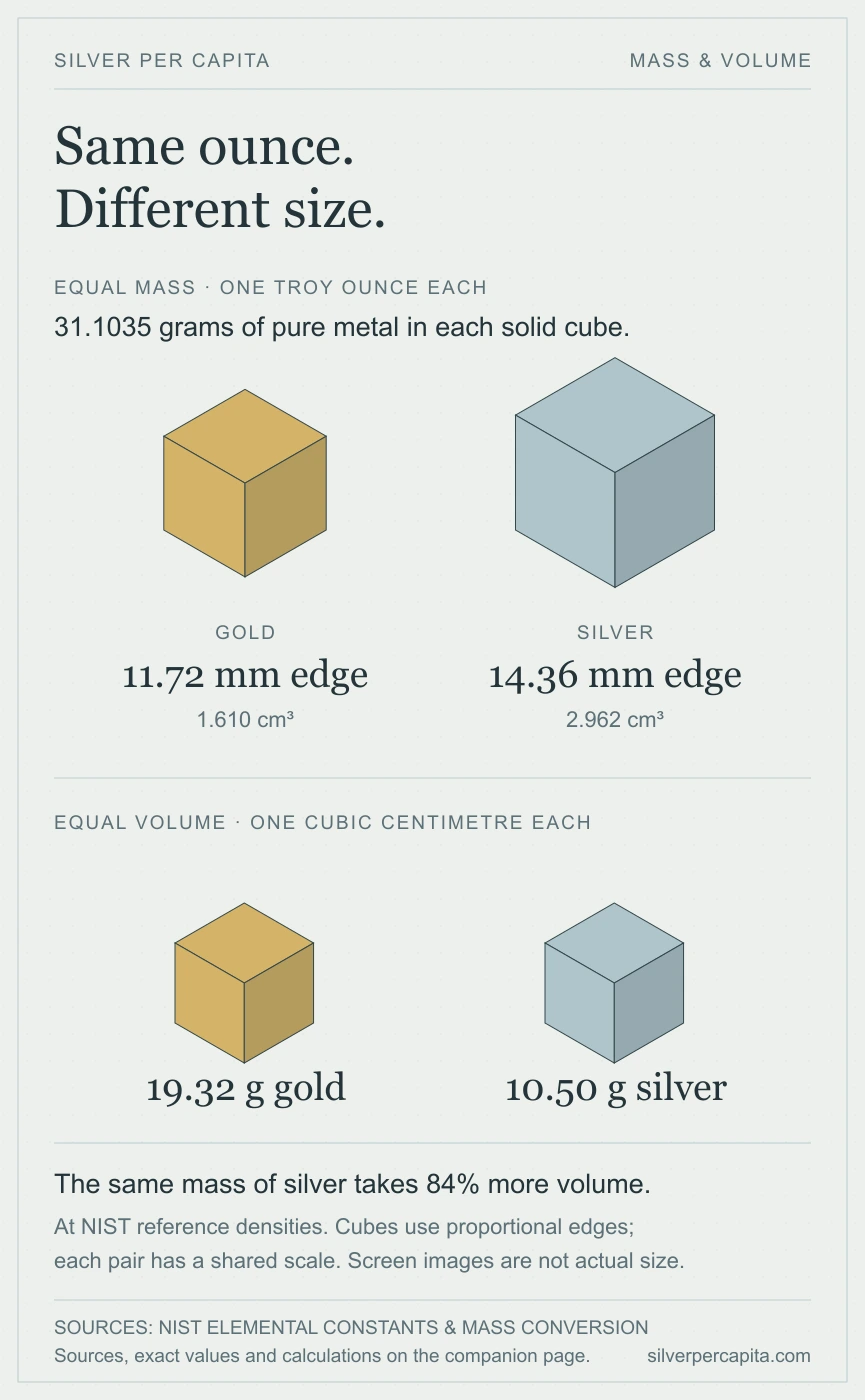
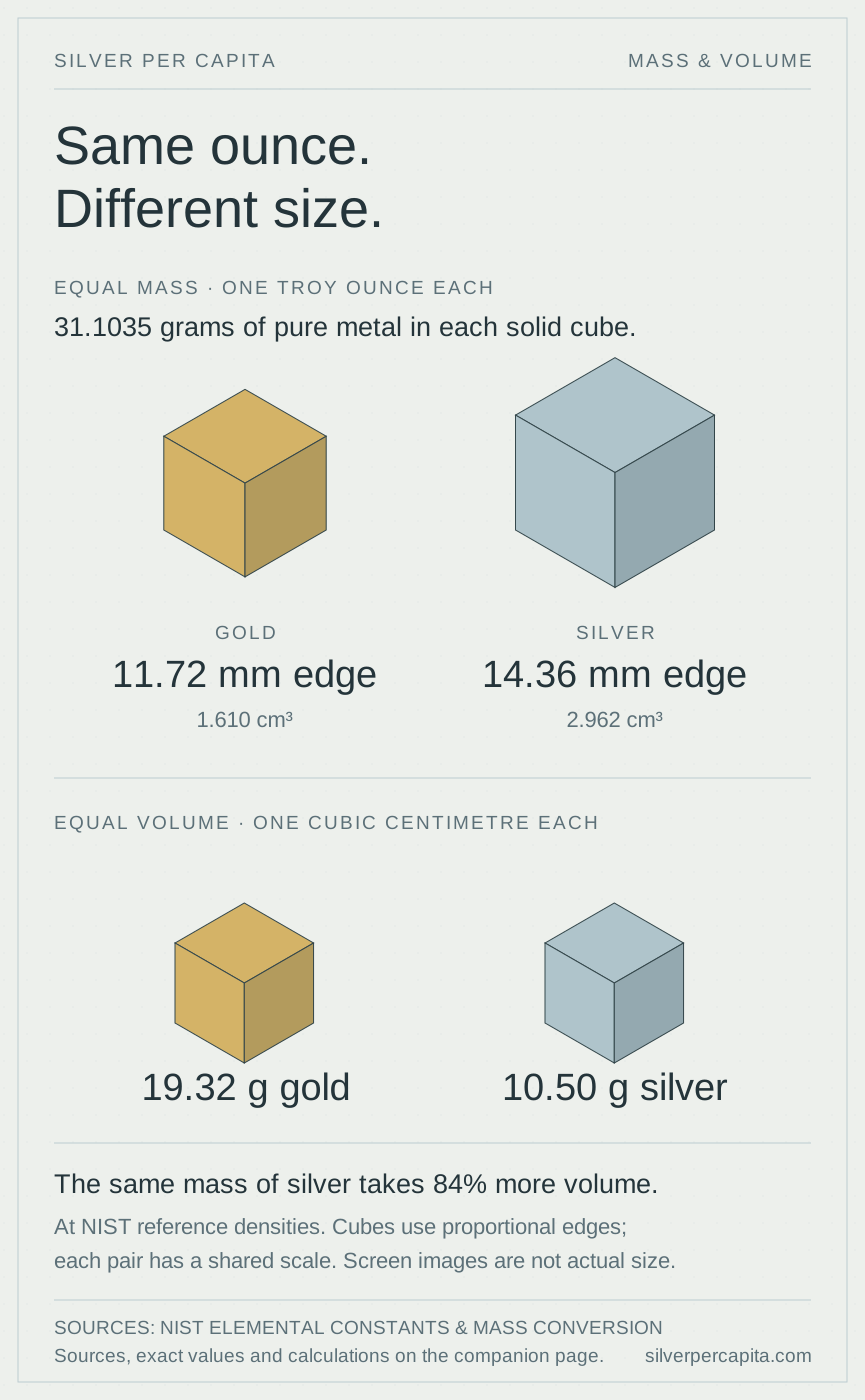
One troy ounce weighs the same for both metals. At NIST's reference densities, that mass occupies about 2.962 cm³ of silver or 1.610 cm³ of gold: 84% more volume for silver.
Equal weight does not mean equal size
A troy ounce is a unit of mass, so a troy ounce of silver and a troy ounce of gold both weigh 31.1034768 grams. Density determines how much space that mass takes up. Using NIST's elemental reference values, gold is 19.32 grams per cubic centimetre and silver is 10.50.
Volume equals mass divided by density. For the same mass, silver therefore occupies 1.84 times the volume of gold. The cube's edge grows by the cube root of that ratio, about 22.5%, rather than by 84%. That is why the visible difference in width is modest even though the volume difference is large.
| Pure metal | Reference density | Volume | Cube edge |
|---|---|---|---|
| Gold | 19.32 g/cm³ | 1.610 cm³ | 11.72 mm |
| Silver | 10.50 g/cm³ | 2.962 cm³ | 14.36 mm |
Why coin diameters cannot tell you the same thing
A coin's diameter depends on its thickness, relief and alloy, as well as its metal content. These solid cubes deliberately remove those design differences. Density alone also cannot authenticate an object: alloys, hollow spaces, coatings and measurement conditions can change the result.
Precious metals usually use troy ounces. The everyday avoirdupois ounce is about 28.3495 grams, making a troy ounce about 9.7% heavier. Check the unit before comparing weights. For a market-price comparison rather than a physical-size comparison, use the gold-to-silver price ratio.
The illustrations use NIST's nominal elemental material constants, not measured densities for particular bars. Cube edge in millimetres = 10 × cube root of (mass in grams ÷ density in g/cm³). Screen dimensions are illustrative.
Sources and calculations
Source checks: 22 October 2026. The graphic is drawn from the accompanying values and formulas. Source data retain their own terms; a downloadable image does not change those terms.
- NIST X-Ray Mass Attenuation Coefficients, Table 1
Elemental media: Ag (Z=47), Au (Z=79), density column in g/cm3
- NIST/NBS Units of Weight and Measure, MP 286
Troy ounces to grams conversion table: 1 troy ounce = 31.1034768 grams
Silver Per Capita. “An ounce of silver takes more space than gold.” 2026-10-22. https://silverpercapita.com/infographics/silver-vs-gold-density